
The Rising Cost of Workplace Safety Failures
Can your construction or mining services business afford to take the risk?
For small and medium-sized contractors, effective workplace safety management is more than a regulatory obligation. It protects people, through preventing avoidable harm all whilst keeping projects moving. Practical workplace safety compliance software can support consistent checks, better reporting and clearer accountability across construction and mining services operations.
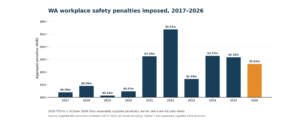
Recent reporting by Business News (5 October 2026) highlighted the consequences of serious workplace safety breaches, including approximately $6.2 million in unpaid fines across eight WA businesses. A separate analysis of the WA WorkSafe conviction data supplied for this article shows that recorded annual court-imposed penalties have fluctuated, but reached $5.34 million in 2022, compared with $375,500 in 2017. The supplied 2026 WHS case summaries add another $2.635 million to 20 October 2026.
These figures are not a forecast of what any one contractor might pay. They demonstrate that substantial financial penalties are a real part of the risk landscape. For smaller construction and mining services businesses, the more important question is whether hazards are identified early, corrective actions are completed and safety processes can be demonstrated when required.
$1.75mReported Single fine following a workplace fatality 2026 | $6.2mReported total unpaid fines across eight WA businesses 2026 |
The consequences go far beyond a fine
A serious incident can bring injury or loss of life, interrupted work, investigations, remediation costs and pressure on client relationships. For a contractor working on tight margins, a prolonged shutdown or loss of a major contract can be as damaging as a financial penalty. Directors and other officers also have their own due diligence duties under work health and safety law; incorporating a company does not automatically remove personal exposure.
The human cost must remain central. No financial calculation captures the impact of a fatality or life-changing injury on workers, families and colleagues.
Why smaller contractors face a difficult challenge
Many businesses have committed supervisors and experienced crews but limited administrative support. Teams move between projects, clients and remote sites. Inductions, licences, equipment pre-starts, digital safety inspections and incident records can be scattered across paper forms, spreadsheets and emails. That makes WHS compliance harder to oversee consistently.
That fragmentation creates a visibility problem. A failed pre-start might not reach the right manager promptly. An expiring qualification might be missed before mobilisation. A corrective action might be assigned but not closed out. Even where work has been performed safely, finding evidence later can take valuable time.
A Digital Safe System of Work: Moving from Reactive Compliance to Proactive Safety
Effective workplace safety is about more than completing inspections and maintaining compliance records. It requires a proactive, connected approach to identifying risks, communicating with workers, developing competencies and managing incidents before they lead to serious consequences.
For construction, mining and industrial organisations, a digital safe system of work brings these critical processes together, embedding safety into everyday operations rather than treating it as a separate administrative function.
- Proactive risk assessments: Identify and manage hazards before work begins through digital risk assessments, Safe Work Method Statements (SWMS), Take 5s and pre-start checks. Workers should reassess changing site conditions and confirm appropriate controls at the point of work.
- Active workplace communications: Keep crews informed through targeted safety alerts, toolbox talks, operational updates and mobile messaging. Track acknowledgements and follow up with workers who have not received or responded to critical information.
- Digital learning management, inductions and training: Use an LMS and competency records to track inductions, safety training, qualifications and refresher requirements. Make workforce readiness visible before people are mobilised or assigned to high-risk tasks.
- Action-based incident and investigation management: Move beyond incident reporting with structured investigations, root-cause analysis, assigned corrective actions, escalation and verified close-out. Use lessons learned to help prevent recurrence.
- Proactive fatigue management: Rostering processes should highlight potentially unsafe shift patterns, excessive hours and inadequate rest, while workers complete a fitness-for-work self-assessment before each shift. Supervisors then need a clear process for reviewing concerns and intervening. These are recommended elements of an integrated safe system of work; specific software functionality should be confirmed before implementation.
- From safety records to safer operations: The value of workplace safety compliance software is not simply replacing paper. It is connecting assessments, communications, training, investigations and fatigue controls to improve visibility and accountability across dispersed teams and remote sites. Technology does not guarantee compliance; competent people, effective supervision and action on identified risks remain essential.
The added complexity of mining services
Mining services contractors often operate across multiple principal-contractor sites, each with its own mobilisation and safety requirements. Missing compliance evidence can delay work even where no incident has occurred. Mining workforce management software can complement safety processes by improving visibility of worker readiness, competencies and site requirements.
Better compliance visibility therefore supports both safer operations and commercial readiness: knowing who is qualified, which equipment is fit for use and which issues still require attention.
Five Practical Steps to Build a Stronger Workplace Safety Culture
Creating a safer workplace starts with leadership, consistent communication and making safety part of everyday operations. These five practical actions are relevant to construction, mining and industrial businesses.
- Make safety a priority — lead by example. Owners, managers and supervisors should set clear expectations, involve workers in safety decisions and provide the time and resources needed to manage risks. Reinforce that work must not proceed when critical controls are missing or conditions are unsafe. Measure the quality of risk management, not just incident-free days.
- Practise active and consistent workforce communication. Schedule and manage toolbox talks, daily pre-starts, safety alerts and field leadership activities. Encourage two-way conversations where workers can raise concerns without fear of repercussions. Record participation, share key messages and follow up on unresolved issues.
- Review and discuss risk assessments regularly. Treat SWMS, Job Safety Analyses and other risk assessments as living documents. Review them with crews whenever tasks, equipment or conditions change. Use pre-start discussions and field observations to confirm that controls are understood, practical and effective.
- Maintain accurate training and competency records. Keep current records of inductions, licences, qualifications, assessments and refresher training. Monitor expiry dates and training gaps, and check that people are competent and authorised before high-risk work is assigned. An LMS and competency register can improve visibility and follow-up.
- Recognise and reward safe behaviours. Acknowledge workers who report hazards and near misses, improve controls, participate in risk reviews or demonstrate strong safety leadership. Recognition might include toolbox shout-outs, team awards or sharing practical improvements. Reward positive action and risk reduction—not simply injury-free periods, which can discourage reporting.
The most effective safety practices are consistently applied, not merely documented. Digital systems can support these habits with timely information, accountability and clear follow-up actions.
Where TOKN fits: Enabling a digital safe system of work
TOKN Technology helps construction, mining services and industrial organisations establish a connected digital safe system of work, bringing together the people, processes and information needed to proactively manage workplace safety. Rather than treating safety as disconnected inspections, forms and compliance activities, TOKN embeds safety management into everyday workforce operations to help identify risks earlier, improve communication and drive timely corrective action.
Proactive risk management: Digital pre-starts, SWMS, workplace inspections and risk assessments help workers identify hazards, assess changing conditions and document controls at the point of work, including at remote sites with limited connectivity.
Active workforce communications: Targeted safety alerts, toolbox talks, operational updates and mobile messaging keep dispersed teams informed. Acknowledgements and reporting give supervisors visibility of who has received critical safety information.
Digital inductions, training and competency management: TOKN’s learning management capabilities support digital inductions, training delivery and completion tracking, while workforce competency records help maintain visibility of licences, qualifications and training requirements.
Action-based incident and investigation management: Digital incident reporting, structured investigations, root-cause analysis and corrective-action tracking help teams respond, address underlying causes and reduce the likelihood of recurrence.
Proactive fatigue management: Connecting rostering with fatigue-risk visibility and pre-shift fitness-for-work assessments can help identify unsafe work patterns and support timely intervention. Automated roster alerts and worker self-assessments should be confirmed as configured or available before being described as live TOKN functionality.
Importantly, TOKN can connect frontline safety processes with broader workforce management and ERP systems where appropriate, helping reduce duplicated administration and improve operational visibility. For construction and mining services businesses, the objective is not to add complexity: it is to make safe work practices easier to follow, risks easier to identify and corrective actions easier to manage.
Protecting people is good business
The annual totals fluctuate, but the scale of penalties in recent years reinforces the financial consequences of serious safety breaches. Avoiding fines should never be the primary purpose of a safety program. The stronger case is protecting people, maintaining operational continuity and building the trust of employees and clients.
If your business still relies on disconnected forms and spreadsheets, consider where practical digital safety inspections and compliance workflows could make the greatest difference. Explore how TOKN supports safer, better-connected construction and mining services operations at www.tokntechnology.com.
Sources and further reading
Sources: WA WorkSafe prosecution conviction spreadsheet supplied for 2017–2025 (all penalty amounts aggregated by conviction year, including values labelled “Global”); four separately supplied 2026 penalties ($1,750,000, $550,000, $200,000 and $135,000) to 1 October 2026; Business News, 5 October 2026, for contextual reporting. The graph represents the supplied records and is not independently verified as an exhaustive register of all WA penalties.
Image alt text: Aggregate WA workplace safety penalties by conviction year from 2017 to 2025, plus $2.635 million in separately reported penalties to 1 October 2026.
The future of mining isn’t people versus technology.
It’s people working better with technology.
www.tokntechnology.com